
A creak at 2 a.m. can turn a comfortable bed into the loudest thing in the room. You roll over, hear a sharp squeak, stop moving, then try again a few minutes later. The good news is that a noisy wooden bed frame does not automatically mean you need a new bed. In many cases, the sound comes from a loose fixing, rubbing slat, moving joint, uneven floor, or a small gap that you can correct.
This guide explains how to find the real source of the noise, why wooden frames creak, which repairs work best, and which quick fixes only mask the problem. You will learn the clear signs you need a new bed when repairs aren’t enough, as well as how to prevent the noise from returning so you can finally sleep without listening to every movement.
Slats: Table of contents
- Why Does a Wooden Bed Frame Creak?
- First, Find Where the Noise Comes From
- Tighten Loose Screws, Bolts and Fixings
- Check the slats for movement.
- Treat Wood-on-Wood Friction
- Inspect the Joints for Gaps or Movement
- Check Whether the Floor Is Causing the Noise
- Check the centre support.
- Make Sure the Frame Is Not Rubbing Against the Wall
- Check the Mattress Before Blaming the Frame
- What If the Creak Comes Back After a Few Days?
- When Should You Replace a Noisy Wooden Bed Frame?
- How to Prevent Future Creaking
- Wooden Bed Frame Noise: A Quick Troubleshooting Order
- FAQs About Wooden Bed Frame Noise
- Conclusion
Why Does a Wooden Bed Frame Creak?
Most bed frame noise starts with movement between two parts. When one piece moves against another, friction creates the familiar squeak or creak. Dreams notes that loose screws, bolts and fittings are common causes, while slats can also rub against the frame. The Sleep Foundation similarly recommends checking fixings, broken slats and friction points before trying more involved solutions.
Wood also reacts to changes in moisture and temperature. Small changes can alter pressure at joints and create new rubbing points. The key is to identify the source before choosing a repair.
First, Find Where the Noise Comes From
Before tightening every screw or adding lubricant, isolate the noise in your wooden bed frame. This one step can save you time and stop you from repairing the wrong part.
Remove the mattress first and place it somewhere safe. Then press down on different areas of the base. Push near each corner, along the side rails, around the headboard, and over the slatted area. Gently shake the frame as well. Dreams recommends removing the mattress and testing different parts of the frame to pinpoint the source.
Listen for the exact point where the sound appears. A noise at the headboard may have a different cause from a squeak under the middle of the mattress.
| What you hear | Likely cause | Best first check |
|---|---|---|
| Sharp squeak at a corner | Loose joint or bolt | Check fixings |
| Repeated rubbing sound | Slat movement | Inspect slats |
| Creak when turning | Frame movement | Test side rails and joints |
| Clicking or tapping | Loose hardware | Check screws and washers |
| Noise from one leg | Uneven floor or foot | Check floor contact |
| Noise only with mattress on | Mattress or mattress-frame contact | Test mattress separately |
Tighten Loose Screws, Bolts and Fixings

The first repair for wooden bed frame noise should always be a careful check of the hardware. A wooden bed frame experiences repeated movement every night, so screws and bolts can loosen gradually. A slightly loose connection may allow enough movement to create noise even when the frame still looks solid.
Use the correct screwdriver or Allen key for each fixing. Tighten the hardware until the joint feels secure, but do not force it excessively. Over-tightening can damage timber, strip a screw head or put unnecessary pressure on the joint.
Work around the whole frame rather than tightening only the noisy corner. Check the headboard connections, side rails, centre supports, leg fittings and any brackets underneath the slats. Once you finish, test the frame again.
If the noise disappears, you have probably found the main cause. If the creak remains, move to the next stage rather than repeatedly tightening the same screw. Dreams also advises checking and tightening fittings as part of regular wooden-bed care.
Check the slats for movement.
Slats can create noise when they move against the frame, shift sideways, or rub against each other. This can happen when a slat does not sit firmly in its support point or when a small gap allows repeated movement.
Inspect each slat for cracks, damage or unusual movement. Press down on each one and listen carefully. If one slat produces the sound, remove it if the design allows and inspect its contact points.
You can reduce friction at contact points with thin felt or another suitable cushioning material. Dreams also suggests felt pads for stabilising noisy slats. The aim is to reduce movement without interfering with the frame’s support or the mattress.
Do not cover a damaged slat with a temporary pad and assume the problem is solved. If a slat has cracked, bent or lost its structural support, replace it with the correct type and size.
Treat Wood-on-Wood Friction
A wooden joint can squeak simply because two timber surfaces rub together under pressure. In that situation, tightening a screw may help, but reducing friction at the contact point can provide a better solution.
For accessible wood-to-wood contact points, a small amount of furniture-safe wax can help reduce rubbing. Dreams recommends wax at problem joints, and other bed-frame guidance also lists wax or similar friction-reducing methods for wood contact areas.
Apply only a small amount and keep it controlled. You do not want excess product spreading onto the floor, bedding or mattress.
Use this method only after you identify the rubbing point. Otherwise, you may mask the symptom instead of fixing the cause.
Inspect the Joints for Gaps or Movement
A joint can remain connected while still moving too much. This often happens when repeated use creates a small gap between connected parts.
Hold one section of the frame firmly and gently move the connected section. You are looking for play or movement that should not be there. Check the areas around bolts, brackets and rail connections.
If the joint has visible damage, cracked timber or enlarged fixing holes, tightening alone may not provide a lasting repair. The joint may need a more suitable fastener, replacement hardware or professional repair.
This is also where you should avoid improvised fixes that change the frame’s structure. Drilling new holes without understanding the load path can weaken the timber rather than strengthen it.
Check Whether the Floor Is Causing the Noise
Sometimes the wooden bed frame gets blamed for a creak that actually starts underneath it.
Place your hand on each leg and gently rock the bed. If one corner moves more than the others, the floor may be uneven or one support may not sit correctly. A small difference in floor level can make the whole frame twist slightly every time you move.
A suitable felt pad or furniture leveller can help stabilise a leg, provided it does not create an unsafe or unstable setup. Dreams also notes that floorboards can contribute to squeaks and that changing the bed position or using a rug may sometimes reduce movement.
Test the bed after stabilising the contact point. If the noise changes when you move the bed to another area of the room, the floor deserves closer attention.
Check the centre support.
Many larger bed frames rely on a centre rail and additional legs or supports. If one support does not contact the floor correctly, the frame can flex when weight moves across the mattress.
Check that the centre support sits firmly and that its feet contact the floor. Look for a loose connection between the centre rail and the side rails. A support that moves even slightly can create a repeated knock or creak.
This area matters more in larger sizes because the sleeping surface spans a wider area. Never remove or ignore a centre support just because the bed seems stable without it. It may play an important structural role.
Make Sure the Frame Is Not Rubbing Against the Wall
A headboard or side of the bed can touch a wall and create a noise that sounds like a frame creak. The bed may move a tiny amount when you turn, then tap or rub against the wall.
Pull the bed slightly away from the wall and test it again. If the noise disappears, the wall contact was part of the problem.
This is one of the easiest fixes because it does not require a repair to the frame itself. It also explains why a bed may become noisy after someone moves it closer to the wall.
Check the Mattress Before Blaming the Frame
A mattress can sometimes create sounds that travel through the bed, making the frame seem responsible. Springs, internal materials and movement between the mattress and base can all change the sound you hear.
Remove the mattress and press different areas by hand. Then test the frame by itself. If the frame stays quiet but the mattress produces the noise, investigate the mattress separately.
Tom’s Guide also recommends checking the mattress as part of the troubleshooting process, while Dreams advises isolating the mattress from the base to identify the true source.
This step matters because replacing or repairing a perfectly good frame will not solve noise that originates elsewhere.
What If the Creak Comes Back After a Few Days?
A repair that works for two nights but fails again in a wooden bed frame usually points to an underlying movement problem.
Start by asking what changed. Did the noise return after heavy use? Did you move the bed? Did the room become more humid or dry? Did you tighten one fixing while another joint remained loose?
Go back through the frame systematically. Check the same location, then inspect the surrounding joints. A creaking sound can travel through timber, so the loudest point is not always the original source.
If the same joint repeatedly loosens, the problem may involve worn hardware, damaged timber or excessive movement. At that stage, repeating the same quick fix will not create a lasting result.
When Should You Replace a Noisy Wooden Bed Frame?
Not every noisy frame needs replacing. A well-built frame with sound timber and secure joints may only need adjustment and maintenance.
Replacement becomes more sensible when you find serious structural damage, several cracked slats, badly worn connection points, repeated joint failure, unstable supports or signs that the frame no longer provides reliable support.
| Problem | Repair or replace? | Why |
|---|---|---|
| Loose screw | Repair | Usually simple to correct |
| Rubbing salt | Repair | Often caused by movement |
| Uneven leg | Repair | Stabilisation may solve it |
| Damaged slat | Usually repair | Replace the affected slat |
| Cracked main rail | Consider replacement | The main structure may be weakened |
| Repeatedly failing joint | Inspect carefully | Hardware or timber may be worn |
| Major structural damage | Replace | Safety and stability come first |
Do not keep using a frame that feels unstable simply because you have managed to make the noise quieter. Quiet does not always mean safe.
How to Prevent Future Creaking
Prevention starts with routine checks rather than waiting for a loud squeak. Every few months, inspect the main fixings and make sure the frame still feels stable. Dreams specifically recommends periodic checks and tightening of bolts and screws as part of wooden-bed care.
Keep the frame away from unnecessary moisture and strong heat sources. Timber can react to environmental changes, and excessive heat or moisture can affect wood over time. Regular dusting and quick cleaning of spills also help keep the frame in good condition.
Wooden Bed Frame Noise: A Quick Troubleshooting Order
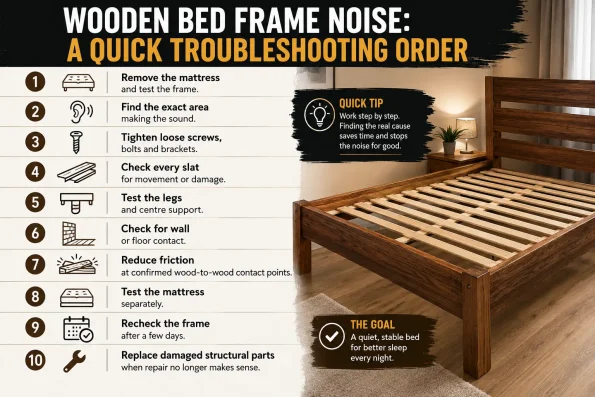
- Remove the mattress and test the frame.
- Find the exact area making the sound.
- Tighten loose screws, bolts and brackets.
- Check every slat for movement or damage.
- Test the legs and centre support.
- Check for wall or floor contact.
- Reduce friction at confirmed wood-to-wood contact points.
- Test the mattress separately.
- Recheck the frame after a few days.
- Replace damaged structural parts when repair no longer makes sense.
Related Article: Curved Furniture Is More Than a Trend
FAQs About Wooden Bed Frame Noise
Why does my wooden bed frame squeak when I move?
The most common reasons include loose fixings, moving slats, wood-to-wood friction, unstable legs or frame movement. Start by removing the mattress and testing each section to find the source.
Can I stop a wooden bed from creaking without replacing it?
Yes. Many squeaks come from fixings or friction points that you can correct. Tightening hardware, stabilising slats and reducing confirmed friction points can often make a major difference.
Should I use WD-40 on a wooden bed frame?
Do not treat WD-40 as the default solution for a timber frame. First identify whether the noise comes from a metal part, a wood joint, or another source. For wood-to-wood contact, a suitable furniture wax may be more appropriate.
Why does my bed creak only at night?
The sound itself may not be related to the time of day. Small temperature or moisture changes can affect timber, and the noise may only become noticeable when the room is quiet.
Can a mattress cause a squeaky bed?
Yes. A mattress can create or transmit sounds, so test it separately from the frame. This helps prevent you from repairing the wrong component.
Why does my new wooden bed frame creak?
A new frame can make noise if a connection has not settled correctly, hardware is not fully secure, a slat is moving, or the frame is not sitting evenly on the floor. Check the assembly and contact points before assuming there is a major defect.
When is a squeaky bed frame unsafe?
Noise itself does not prove that a frame is unsafe. However, you should take instability, cracked structural timber, broken slats, loose major supports or repeated joint failure seriously. Stop using a frame if it no longer feels structurally reliable and arrange an appropriate repair or replacement.
Conclusion
Wooden bed frame noise can sound like a major problem, but the cause is often much smaller than the noise suggests. Loose fixings, moving slats, rubbing joints, uneven floor contact and mattress noise can all create sounds that seem mysterious at first.
The smartest solution is not to guess. Remove the mattress, isolate the source, inspect the joints, check the slats and supports, and test the floor and mattress separately. Then choose the repair that matches the real cause.
A well-maintained frame should not need constant attention. Once you fix the actual source rather than masking the sound, you can enjoy a quieter, more stable bed and get back to what matters most: sleeping without every turn becoming a midnight concert.